Treatments / Cream / Spray

Clobetasol propionate 0.05%

Cream / Spray · Topical

The most potent class of topical steroid, reserved for severe, treatment-resistant eczema on thick-skinned areas, with strict limits on how long it can be used.

Available now

Included in your plan if prescribed · Rx required

You won’t be charged until a clinician reviews and approves your case.

Start your assessment →

Not sure this is right for you? Take the quiz →

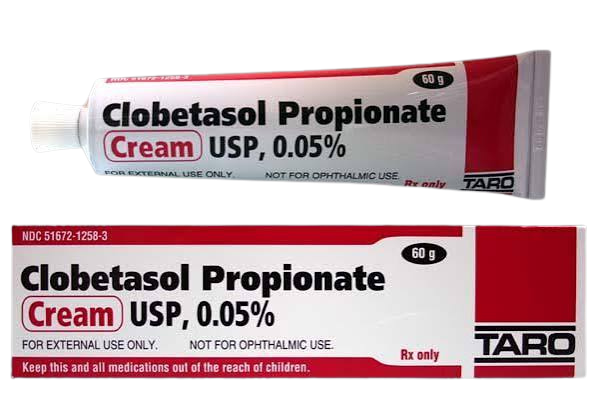
Clobetasol propionate 0.05% cream tube

Why is Clobetasol propionate 0.05% included?

Clobetasol propionate 0.05% is Class I, the highest potency tier in the US classification system. It is not a default option for eczema and most patients will never need it. It's in the formulary because some presentations require it: severely thickened, lichenified patches on the trunk or extremities that have failed multiple mid-potency courses, eczema on the palms and soles where barrier dysfunction is extreme, or acute severe flares in adults where speed of clearance is the clinical priority.

The spray formulation has specific utility for eczema affecting the scalp and hair-bearing areas, where creams are difficult to apply and ointments are not practical. For body or scalp involvement that has proven refractory to lower-potency treatments, clobetasol can achieve clearance within days that other agents cannot match in the same timeframe.

Prescribing clobetasol is always accompanied by explicit instructions about duration and area limits. It is not a drug to use whenever flares occur, it's a short-course intervention for specific situations.

How does it work?

Clobetasol propionate's extreme potency comes from a combination of structural features: a fluorine atom at the 9-alpha position, a chlorine at the 21 position, and the propionate ester, all of which dramatically increase glucocorticoid receptor affinity and skin penetration compared to lower-potency agents. Its receptor binding affinity is many times that of hydrocortisone. This means even a small amount, applied to a limited area, produces intense suppression of the inflammatory cascade: rapid, near-complete shutdown of NF-κB-driven cytokine production, pronounced vasoconstriction, and significant barrier-level anti-inflammatory activity.

The spray formulation delivers the molecule in a volatile carrier that evaporates quickly, allowing penetration without the occlusive effect of a cream or ointment. This makes it useful for hairy areas where other vehicles don't work as well.

How strong is the evidence?

Clobetasol propionate has strong RCT evidence for both atopic dermatitis and psoriasis, including several trials specifically examining short-course (2-week) use for severe flares. It consistently outperforms mid-potency agents on speed of clearance and complete response rates for thick, established lesions. The FDA-approved labeling specifically includes atopic dermatitis.

The evidence also clearly establishes the risk profile with extended use, which is why the 2-week maximum course limit is a regulatory and clinical consensus position, not an arbitrary caution.

What are the limitations and risks?

Clobetasol carries the highest risk of side effects of any topical steroid in the formulary. HPA axis suppression, reduced endogenous cortisol production, is a documented consequence of using clobetasol over large surface areas or for extended periods. Even at normal therapeutic doses over 2 weeks, measurable cortisol suppression has been observed in clinical studies, though it typically reverses after discontinuation.

Skin atrophy can occur rapidly. Two weeks of daily application on thin-skinned areas (which should not happen but occasionally does) can produce visible atrophy. On appropriate thick-skinned areas, atrophy is less of an immediate concern but accumulates with repeated courses. Stretch marks and telangiectasia are possible with repeated use over the same sites.

The FDA-approved label limits use to 2 consecutive weeks on any area. Do not exceed this independently. If the flare hasn't fully cleared in 2 weeks, that's a signal for clinical escalation, to systemic therapy or a biologic, not for extending the topical steroid course.

Frequently Asked Questions

Generally, yes. Clobetasol is a step-up agent for situations where mid-potency or high-potency steroids haven't produced adequate clearance, or where the initial severity warrants the most potent topical option immediately. Your clinician won't prescribe this for a mild-to-moderate first flare.

The FDA-approved limit is 50g per week for cream/ointment formulations, with a maximum 2-week continuous course. These limits exist because exceeding them significantly increases the risk of HPA axis suppression. Your clinician will specify the exact amount and area.

Brief re-treatment after a break (typically several weeks) is sometimes appropriate for recurrent thick-plaque disease, but this should be clinician-guided, not self-managed. Repeated courses on the same area over months will cause progressive atrophy. If you're needing clobetasol repeatedly, that's a signal to discuss longer-term management options, this isn't a drug for ongoing maintenance.

Topical steroid withdrawal (TSW), sometimes called red skin syndrome, is a condition where skin rebounds severely after stopping long-term topical steroid use, becoming intensely red, burning, and inflamed well beyond the original eczema distribution. The risk is highest with high-potency steroids used daily for extended periods and then stopped abruptly. A properly supervised 2-week clobetasol course is not the typical profile for TSW; the risk increases substantially with months of overuse. If you're concerned about this, be completely transparent with your clinician about your steroid use history.

The spray is specifically designed for use on scalp and other hair-bearing areas where cream is difficult to apply and distribute evenly. It delivers the same molecule but in a faster-drying carrier. For non-scalp body areas, the cream is preferred. If your eczema affects both scalp and body, your clinician may prescribe both vehicles.

If you're needing clobetasol-level treatment regularly, more than two courses per year on the same areas, or if even clobetasol isn't producing adequate clearance, that's the signal that topical treatment alone isn't sufficient. The next step is typically a discussion of systemic immunomodulators or biologics (dupilumab, tralokinumab) that address the underlying immune dysregulation rather than just its skin manifestation.

Ready to get a personalized treatment plan?

Fern clinicians review every case individually. Most patients hear back in under 3 hours.

Start your free assessment →
Dr. Chethana Gottam, M.D., Board Certified Dermatologist

“There’s a specific look I recognize in eczema patients who’ve been managing on their own too long. They’ve stopped believing it can get better. Fern shortens that window of suffering. It gets people into real treatment before hopelessness sets in.”

Dr. Chethana Gottam, M.D.
Board Certified Dermatologist