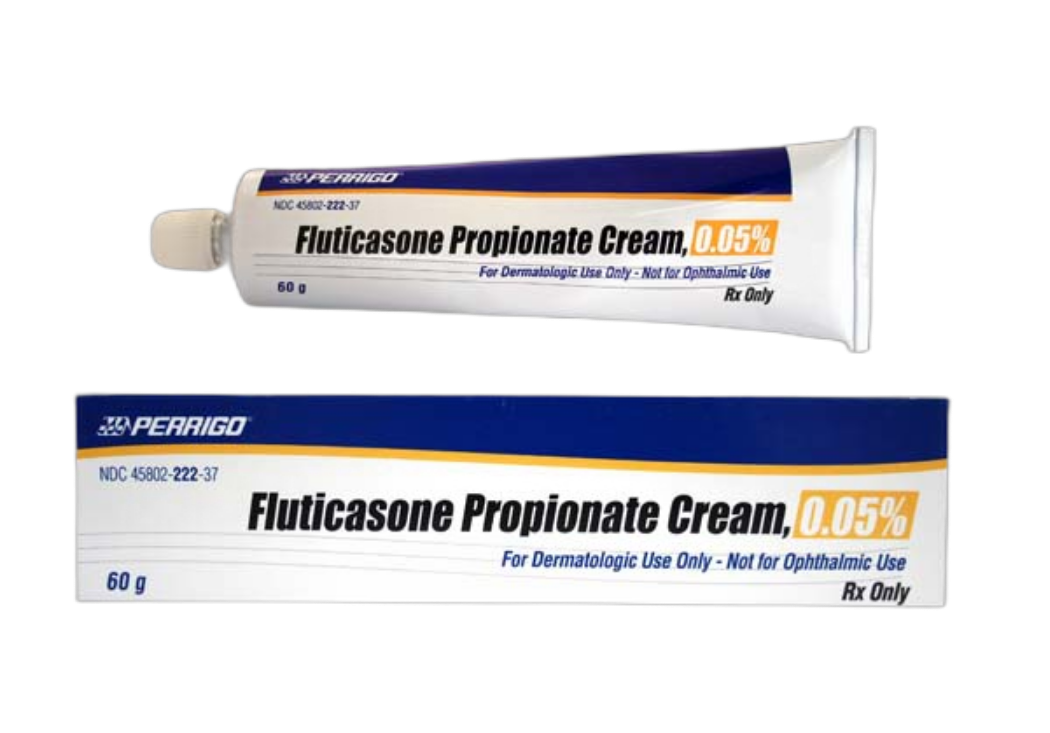
Fluticasone propionate 0.05%
Cream · Topical
A mid-potency steroid with unusually strong evidence for both clearing active flares and preventing new ones with regular maintenance dosing.
Available nowIncluded in your plan if prescribed · Rx required
You won’t be charged until a clinician reviews and approves your case.
Start your assessment →Not sure this is right for you? Take the quiz →
Why is Fluticasone propionate 0.05% included?
Fluticasone propionate 0.05% cream (originally branded as Cutivate) occupies the same mid-potency tier as triamcinolone, but it has one clinically important distinction: it's among the most extensively studied topical steroids for proactive maintenance therapy, the practice of applying medication twice weekly to previously affected skin even when it's currently clear, to prevent flares from returning. For patients with recurring eczema in the same locations, this is the approach that changes the treatment paradigm from constant reactive firefighting to actual long-term control.
Fluticasone is a fluorinated corticosteroid with a good balance of potency and tolerability, and its pharmacokinetic profile, it metabolizes to inactive compounds quickly in the bloodstream, gives it a lower systemic absorption concern than some other mid-potency fluorinated agents. This is partly why it was selected in several of the major proactive dosing trials: researchers wanted to study maintenance therapy with a compound where systemic effects were less of a confounding factor.
How does it work?
Fluticasone binds to glucocorticoid receptors in skin cells with high affinity, its binding affinity for the glucocorticoid receptor is substantially higher than hydrocortisone, which contributes to its mid-potency classification despite a relatively modest concentration (0.05%). Once bound, it suppresses the transcription of pro-inflammatory cytokines, reduces mast cell activity, and causes vasoconstriction in inflamed dermis, reducing the redness and swelling of active lesions.
What makes it particularly useful in the maintenance context: even at twice-weekly application to skin that appears clinically normal, it suppresses the subclinical inflammation that precedes a visible flare. Eczema-affected skin isn't truly "normal" between flares, it retains a low-grade inflammatory state that the twice-weekly dose keeps in check.
How strong is the evidence?
Fluticasone propionate has one of the largest controlled trial programs of any topical steroid, including specific RCTs for atopic dermatitis maintenance therapy. The landmark Berth-Jones et al. trials demonstrated that twice-weekly fluticasone 0.05% cream applied to previously affected areas significantly reduced the time to first relapse and the number of relapses over 16 weeks compared to vehicle alone. This isn't marginal, it's a meaningful clinical effect that has shaped how dermatologists approach long-term AD management.
For acute flare treatment, it performs comparably to other mid-potency agents: significantly better than low-potency steroids on the body, faster clearance than vehicle, and consistent results across multiple short-term RCTs. It's listed as a mid-potency option in AAD and European guidelines.
What are the limitations and risks?
The same fluorinated mid-potency cautions apply: not for the face, not for skin folds, not for prolonged uninterrupted daily use. Twice-weekly proactive dosing has a meaningfully different risk profile from daily reactive dosing, the lower frequency substantially reduces atrophy risk, but the off-limits areas remain off-limits regardless of frequency.
Fluticasone's high receptor affinity means it should be used as directed rather than liberally. More is not better, the skin's glucocorticoid receptors saturate at low concentrations, so doubling the amount applied doesn't increase efficacy but does increase systemic exposure.
Do not use on infected skin. The risk calculus here is the same as for all topical steroids: applying an immunosuppressive agent to actively infected eczema can worsen the infection while appearing to reduce inflammation superficially.
Frequently Asked Questions
Proactive dosing means applying fluticasone twice weekly to skin that has previously been affected, even when it looks normal. You're a candidate if you have recurring flares in the same areas, typical patterns include the antecubital and popliteal fossae (inside elbows, behind knees), the wrists, and the neck. If your flares consistently return to the same locations, twice-weekly maintenance is worth a conversation with your clinician.
Pick two consistent days per week (e.g., Monday and Thursday). Apply a thin layer to the areas that historically flare, even if they look completely clear. This is different from how most people use topical steroids (only when it gets bad) and it requires some discipline, but the evidence for flare prevention is strong. Continue daily moisturizer on all days.
The 16-week maintenance trials did not show significant cutaneous atrophy or HPA axis suppression with twice-weekly dosing. It's meaningfully safer than daily use. That said, "long-term" beyond 16 weeks hasn't been studied in the same controlled way, and periodic check-ins with your clinician are appropriate.
The neck is a borderline area, thinner skin than the trunk but not as thin as the face. Many clinicians will allow brief courses on the neck with triamcinolone or fluticasone, but won't recommend ongoing maintenance dosing there. If your neck is a problem area, tacrolimus ointment (a non-steroid) is often a better long-term option specifically for the neck and upper chest.
Tachyphylaxis is possible but less common at twice-weekly maintenance dosing than with daily use. If you're finding it less effective over time, this is worth raising, your clinician may suggest a short break to restore sensitivity, switching the maintenance agent, or evaluating whether the underlying disease activity has changed.
Both are mid-potency fluorinated steroids and both work similarly for acute flares. Fluticasone's differentiator is the proactive dosing evidence and its pharmacokinetic profile (faster systemic inactivation). In practice, your clinician may choose one over the other based on which areas are affected, whether you're in acute treatment or maintenance mode, and your prior response history.
Ready to get a personalized treatment plan?
Fern clinicians review every case individually. Most patients hear back in under 3 hours.
Start your free assessment →This information is for educational purposes only and is not medical advice. Consult with a healthcare provider before starting any treatment.
“There’s a specific look I recognize in eczema patients who’ve been managing on their own too long. They’ve stopped believing it can get better. Fern shortens that window of suffering. It gets people into real treatment before hopelessness sets in.”