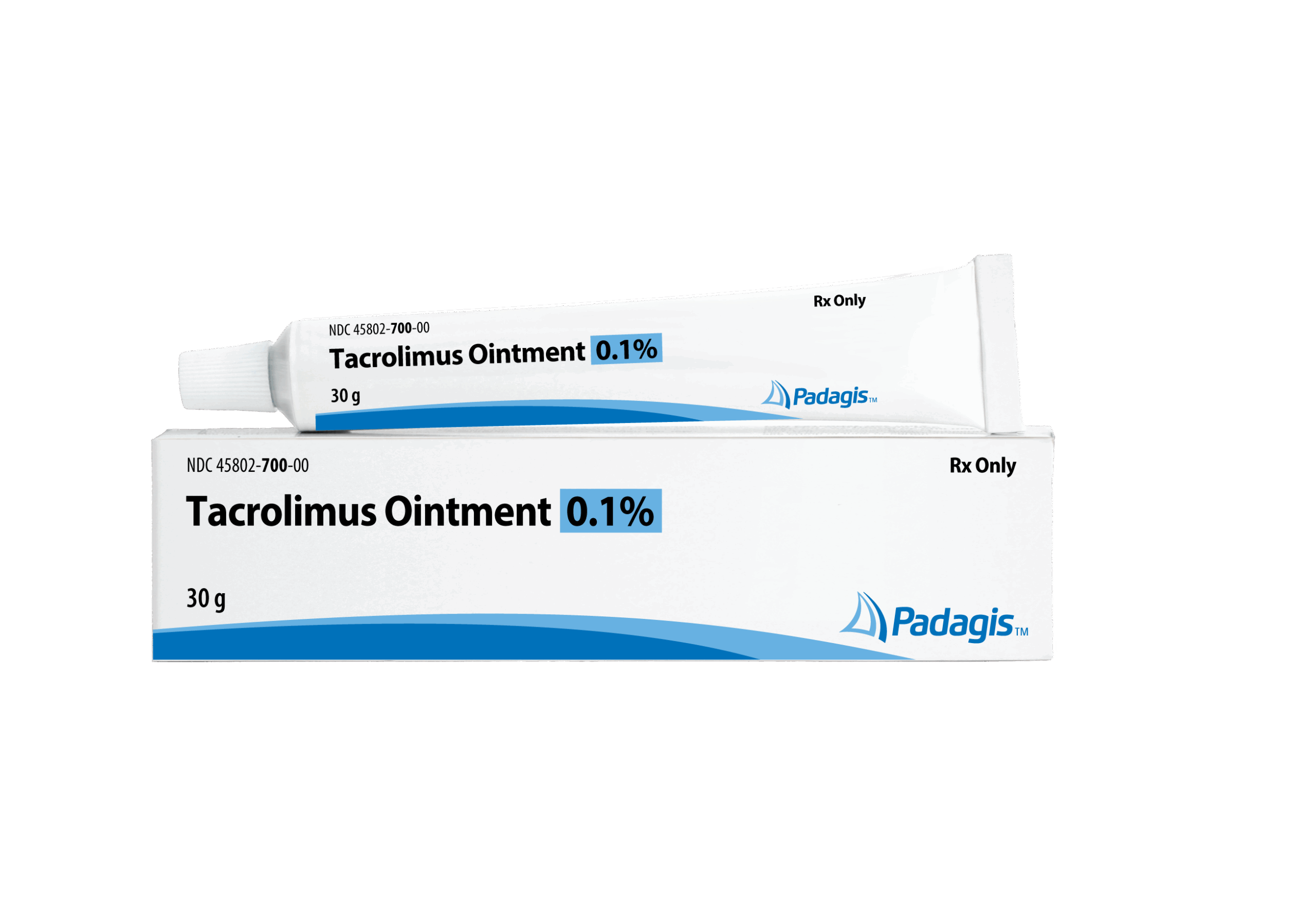
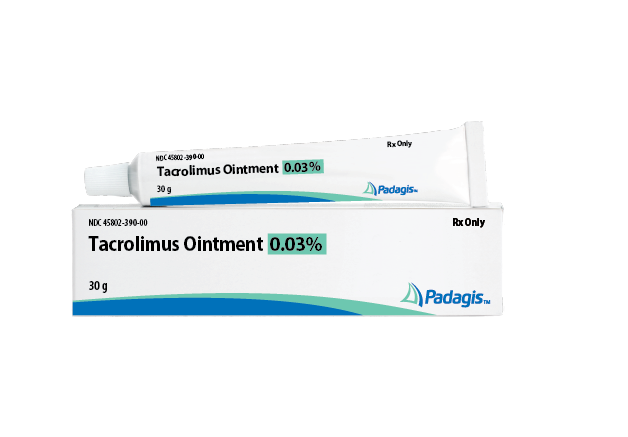
Tacrolimus 0.1%
Ointment · Topical
A non-steroidal anti-inflammatory that works through a completely different mechanism than corticosteroids, no skin thinning, no HPA suppression, making it specifically suitable for long-term use on the face and other sensitive areas.
Available nowIncluded in your plan if prescribed · Rx required
You won’t be charged until a clinician reviews and approves your case.
Start your assessment →Not sure this is right for you? Take the quiz →
Why is Tacrolimus 0.1% included?
Tacrolimus 0.1% ointment solves a specific problem in eczema management: what to use when topical steroids can't be used chronically on the face, eyelids, and neck without accumulating atrophy risk. These are the areas where eczema recurs most visibly, most distressingly, and where patients most want effective long-term options. But they're also where dermatologists are most cautious about topical steroids.
Tacrolimus is a calcineurin inhibitor (a fundamentally different class of anti-inflammatory. It doesn't bind glucocorticoid receptors, doesn't affect collagen synthesis, and doesn't cause skin thinning regardless of how long it's used. This isn't a minor distinction; it changes the treatment calculus for facial eczema specifically. Patients who have been managing with intermittent low-potency steroids on the face) managing but not maintaining control, often achieve dramatically better outcomes with tacrolimus because they can actually use it as often as needed without accumulating risk.
The 0.1% concentration is FDA-approved for adults with moderate-to-severe atopic dermatitis. The lower 0.03% concentration is the pediatric and sensitive-area option. For adults with established moderate-to-severe facial or flexural eczema, 0.1% is the standard prescription strength.
How does it work?
Tacrolimus inhibits calcineurin (an enzyme inside T-cells that is required to activate a transcription factor called NFAT (Nuclear Factor of Activated T-cells). Without NFAT activation, T-cells can't produce the cytokines) IL-2, IL-4, IL-5, IFN-γ, that drive the adaptive immune response underlying eczema. In simpler terms: the immune cells in the skin that are overreacting to triggers can't send the chemical messages that amplify the inflammatory response, so the cascade never gets going.
This mechanism is completely separate from the glucocorticoid receptor pathway. Tacrolimus doesn't suppress inflammation by telling the body to produce fewer inflammatory molecules globally, it specifically blocks the T-cell activation signal that tells the immune system to mount an adaptive response. The result is targeted immunosuppression in the skin without the structural side effects of steroids.
How strong is the evidence?
Tacrolimus 0.1% ointment is FDA-approved for atopic dermatitis in adults, based on multiple large phase III RCTs. The pivotal trials demonstrated it was significantly more effective than vehicle for reducing EASI scores, itch severity, and physician global assessment in moderate-to-severe AD. It was also compared directly to mid-potency topical steroids in some trials and showed comparable efficacy for facial and flexural involvement.
The evidence for long-term maintenance use is particularly strong: multiple studies lasting 12 months or more show that continuous or proactive twice-weekly tacrolimus maintains clearance without progressive loss of effect (unlike tachyphylaxis seen with steroids) and without accumulating atrophy. The absence of atrophy has been confirmed histologically, biopsy studies show no change in skin collagen or epidermal thickness with long-term use.
What are the limitations and risks?
The main side effect is application site burning and stinging, especially in the first few applications. This is a direct consequence of tacrolimus activating TRPV1 (vanilloid) receptors in nerve fibers in the skin, it's a nociceptive effect, not a sign of damage or allergy. It typically diminishes significantly within the first week of use as those receptors become desensitized. Applying to skin that is actively very inflamed or open tends to cause more stinging; if this is intolerable at first, your clinician may recommend starting with low-potency steroids to reduce acute inflammation before transitioning to tacrolimus.
There is an FDA black box warning on tacrolimus (and pimecrolimus, the other calcineurin inhibitor) regarding a theoretical increased risk of lymphoma and skin cancer with long-term use. This warning is controversial. The signal came from animal studies using systemic doses orders of magnitude higher than what's achieved with topical application, and from case reports of lymphoma in severely immunocompromised patients with organ transplants on oral tacrolimus. Multiple large epidemiological studies in patients using topical tacrolimus have not found an increased cancer risk compared to matched AD patients not using it. The warning has not been rescinded because the FDA requires caution in the absence of definitive long-term safety data, but the prevailing clinical and academic view is that the risk from topical use at therapeutic doses is negligible. You should know about this warning and you can ask your clinician to discuss it with you.
Frequently Asked Questions
Cost and the black box warning are the two reasons. Generic topical steroids are extremely inexpensive. Tacrolimus ointment, while available generically, is still substantially more expensive. Insurance coverage can be inconsistent. The black box warning also causes some hesitancy in prescribers despite the reassuring epidemiological data. In terms of mechanism and side effect profile for facial eczema specifically, there's a reasonable argument that tacrolimus should be used earlier than it currently is.
Most patients notice significant reduction in the burning and stinging within 3–5 days of consistent use. Applying to slightly cooler skin (not immediately after a hot shower), using smaller amounts, and having the skin in good baseline condition (moisturized, not acutely open) can reduce initial stinging. Do not stop using it after the first application because of stinging, this is the most common reason patients abandon it prematurely, and the benefit comes after the desensitization period.
Yes: this is one of the key advantages of tacrolimus over steroids. Daily use on the face and flexural areas is appropriate, and there's no known accumulation of atrophy or other structural damage with prolonged daily use. Twice-weekly maintenance use is also well-studied and effective for preventing recurrences. Your clinician will specify which approach is right for your presentation.
Tacrolimus is formulated as an ointment because the ointment vehicle provides better penetration and efficacy. Pimecrolimus (the other calcineurin inhibitor, not in Fern's current formulary) is available as a cream and is sometimes preferred for that reason, though it's lower-potency than tacrolimus 0.1%. Some patients find the greasy feel of the ointment difficult to tolerate, especially on the face. Applying it at night and sleeping with it on often works better cosmetically than trying to use it during the day under makeup or in warmer weather.
Tacrolimus is specifically used off-label for eyelid eczema and is the preferred long-term treatment for many dermatologists for this location. It doesn't cause glaucoma risk (unlike topical steroids used around the eyes), doesn't thin the eyelid skin, and can be used chronically. Apply a very small amount to the eyelid skin, avoiding getting it in the eye itself. Mild stinging is expected initially.
Tacrolimus does suppress T-cell activity locally in the skin, which has implications for skin infections. Eczema herpeticum (severe herpes simplex spread across eczematous skin) is a concern with all topical immunosuppressive treatments including tacrolimus, if you develop unusual blister clusters, pain, or fever on treated skin, seek immediate medical attention. For bacterial infections (impetigo, Staph), tacrolimus use during active infection should be paused. The local immunosuppression from topical use doesn't cause the systemic immunosuppression associated with oral tacrolimus (used in transplant medicine).
Ready to get a personalized treatment plan?
Fern clinicians review every case individually. Most patients hear back in under 3 hours.
Start your free assessment →This information is for educational purposes only and is not medical advice. Consult with a healthcare provider before starting any treatment.
“There’s a specific look I recognize in eczema patients who’ve been managing on their own too long. They’ve stopped believing it can get better. Fern shortens that window of suffering. It gets people into real treatment before hopelessness sets in.”