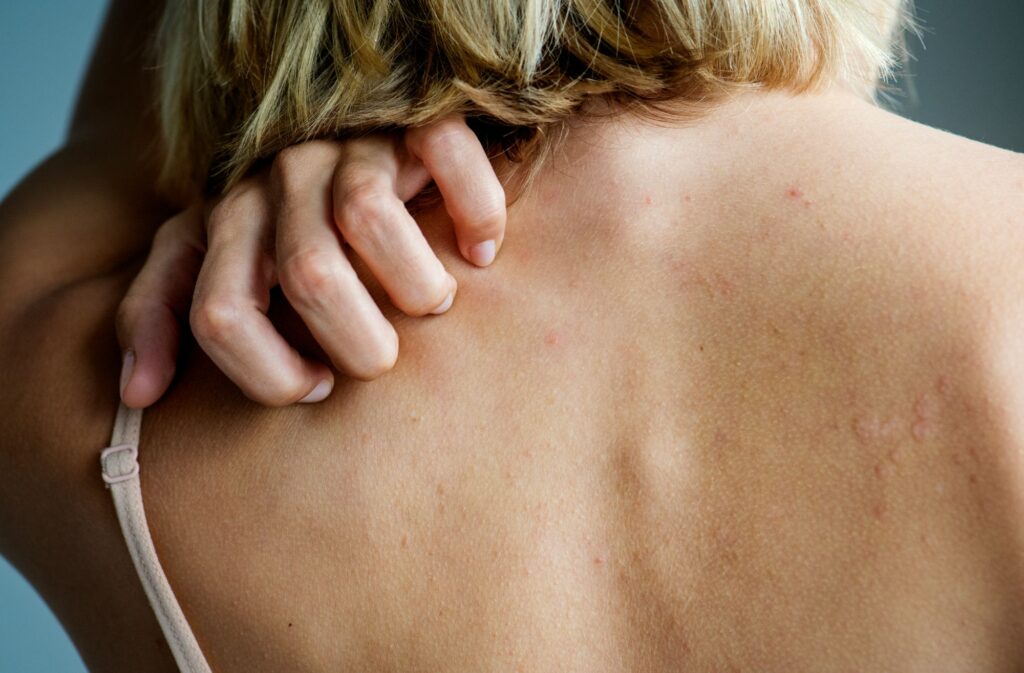
You’ve got a red, itchy patch of skin that won’t quit. Google says it could be eczema, psoriasis, fungal infection, contact dermatitis, or — if you scroll far enough — something terrifying. Let’s narrow it down.
Eczema (atopic dermatitis) is one of the most common skin conditions on the planet, affecting an estimated 31.6 million people in the United States. But it’s also one of the most frequently confused with other conditions. Getting the right diagnosis matters because the treatments are different — and using the wrong one can actually make things worse.
Here’s how to tell what you’re actually dealing with.
Eczema: the basics
Atopic dermatitis typically shows up as:
- Intense itching — often the itch comes before the rash, not after
- Red, inflamed patches (on lighter skin) or darker brown/purple/gray patches (on darker skin)
- Dry, scaly, or cracked skin that may weep or crust during flares
- Common locations: inner elbows, behind the knees, neck, wrists, hands, face
- Pattern: chronic and relapsing — it comes and goes over months or years
Eczema is driven by a combination of genetic barrier dysfunction and immune system overactivity. If you have a personal or family history of eczema, asthma, or hay fever (the “atopic triad”), the odds tilt strongly toward AD.
Conditions that mimic eczema
Psoriasis
How it looks: Thick, well-defined, silvery-white scaly plaques. Psoriasis patches tend to have sharper borders than eczema.
Where it shows up: Elbows (outer surface — eczema prefers the inner crease), knees, scalp, lower back, nails.
Key difference: Psoriasis is less intensely itchy than eczema (though it can itch). The scales are thicker and more silvery. Psoriasis also commonly affects the nails, causing pitting or discoloration.
Why it matters: Psoriasis is an autoimmune condition with a different treatment pathway. Some eczema treatments (like certain moisturizers) help, but the prescription approaches diverge significantly.
Contact dermatitis
How it looks: Red, itchy, sometimes blistered skin — can look almost identical to eczema.
Key difference: Contact dermatitis is caused by a specific external trigger — either an irritant (soap, bleach, solvents) or an allergen (nickel, latex, fragrance, poison ivy). The rash appears where the substance touched the skin, and there’s usually a clear cause-and-effect timeline.
Why it matters: Treatment centers on identifying and avoiding the trigger. If you remove the offending substance, the rash resolves. Atopic dermatitis, by contrast, persists because the underlying barrier dysfunction doesn’t go away.
Seborrheic dermatitis
How it looks: Red, flaky, greasy-looking patches, often with yellowish scales.
Where it shows up: Scalp (dandruff is mild seborrheic dermatitis), eyebrows, sides of the nose, behind the ears, chest.
Key difference: The greasy, yellowish quality of the scales and the concentration in oil-rich areas. Eczema tends to be dry; seborrheic dermatitis tends to be oily.
Fungal infections (tinea / ringworm)
How it looks: Red, scaly patches that may form a ring shape with clearer skin in the center.
Key difference: Fungal infections are often asymmetric (one hand, one foot, one side). Eczema is typically bilateral — affecting both sides roughly equally. Fungal patches tend to expand outward in a ring pattern, which eczema doesn’t do.
Why it matters: Antifungal treatment clears fungal infections. Topical steroids (the go-to for eczema) can actually make fungal infections worse by suppressing the local immune response.
Scabies
How it looks: Intensely itchy bumps or blisters, often in lines or clusters.
Where it shows up: Between fingers, wrists, waistline, armpits, genitals.
Key difference: Scabies itch is extreme, often worse at night, and may affect other people in your household simultaneously. It’s caused by mites, not immune dysfunction.
A quick self-check
Ask yourself these questions:
Does it run in the family? A history of eczema, asthma, or allergies in your family is a strong signal for AD.
Where is it? Inner elbows, behind knees, neck, and hands lean toward eczema. Outer elbows and scalp lean toward psoriasis. Oily areas lean toward seborrheic dermatitis.
Is it symmetrical? Both arms, both legs, both hands? Likely eczema. One-sided? Consider fungal or contact dermatitis.
What came first — the itch or the rash? Itch-first is a hallmark of eczema.
Did something new touch your skin? New soap, jewelry, detergent, or latex? Think contact dermatitis.
This self-check can point you in the right direction, but it’s not a substitute for a clinical evaluation — especially because conditions can overlap, and getting the wrong treatment wastes time and money.
The fastest way to get answers
You could spend weeks waiting for a dermatologist to tell you what you’re dealing with. Or you could get evaluated by a licensed clinician who specializes in skin conditions — from your phone, in under 48 hours.