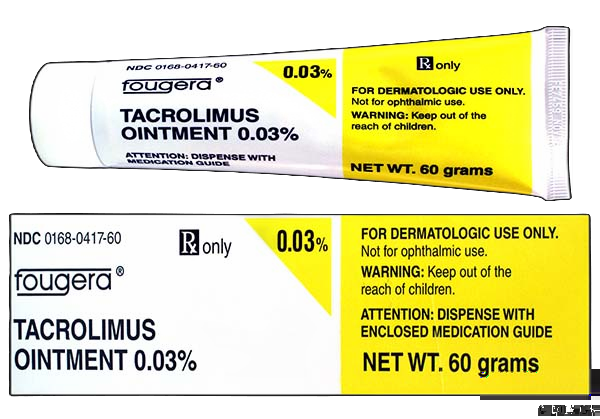
Tacrolimus 0.03% ointment is FDA-approved for atopic dermatitis in patients aged 2 to 15 — the only non-steroidal prescription topical indicated specifically for the pediatric age group. It addresses the most persistent challenge in childhood eczema: the face.
Facial eczema is both the most visible and the most emotionally difficult aspect of eczema in children, and it’s where topical steroids present the hardest trade-off — effective short term, but not appropriate for continuous long-term use because of atrophy risk in growing skin. Tacrolimus doesn’t bind glucocorticoid receptors and doesn’t affect collagen or elastin synthesis, so it can be part of long-term disease control without structural cost. The 0.03% strength is the FDA-approved pediatric dose; 0.1% is not approved for children under 16.
Tacrolimus inhibits calcineurin, an enzyme T-cells need to activate NFAT — the transcription factor T-cells need to produce inflammatory cytokines including IL-2, IL-4, IL-5, and IFN-γ. Without NFAT, the T-cell–driven cascade sustaining eczema cannot amplify. The skin retains normal immune function — it can still respond to infections — but the hyperreactive response that constitutes eczema is suppressed at its source.
Because tacrolimus is entirely independent of the glucocorticoid receptor pathway, it has no effect on collagen, elastin, or HPA-axis cortisol production. Treated skin looks and behaves structurally the same after months or years of use. Transient burning or stinging in the first days of use is a direct effect on skin nerve fibers (TRPV1 activation) — not a sign of damage — and typically resolves within 3–5 days as those receptors desensitize.
Tacrolimus 0.03% ointment received FDA pediatric approval following dedicated phase III RCTs in children aged 2–15. Pivotal trials demonstrated significantly greater reduction in EASI scores versus vehicle, comparable efficacy to mild-to-moderate potency topical steroids for facial eczema, and — crucially — no skin atrophy on histological examination with up to 12 months of use.
Long-term safety studies specifically in children confirm no cumulative skin structural changes, no HPA-axis suppression, and no growth effects with 0.03% over periods of a year or more. This is the longitudinal data that supports its role as a genuine long-term management tool.
Application-site burning and stinging is the main side effect in children, and often more challenging to manage because a child who experiences discomfort is less likely to cooperate. This is a direct pharmacological effect that resolves within 3–5 days as skin nerve fibers desensitize. Preparing the child and parent for this in advance — framing it as temporary and expected — dramatically improves continuation. Some families apply at night after the child is asleep.
Tacrolimus carries an FDA boxed warning about a theoretical risk of lymphoma and skin cancer with long-term use. The theoretical concern came from animal studies at doses far exceeding topical application and from organ-transplant patients on systemic (oral) tacrolimus. Large post-marketing studies following children who used topical tacrolimus have not found any increased rate of lymphoma or skin cancer. Not appropriate for infected skin — eczema herpeticum (herpes simplex spreading across eczematous skin) is a contraindication. Disclose any history of cold sores or recurrent HSV to your clinician.