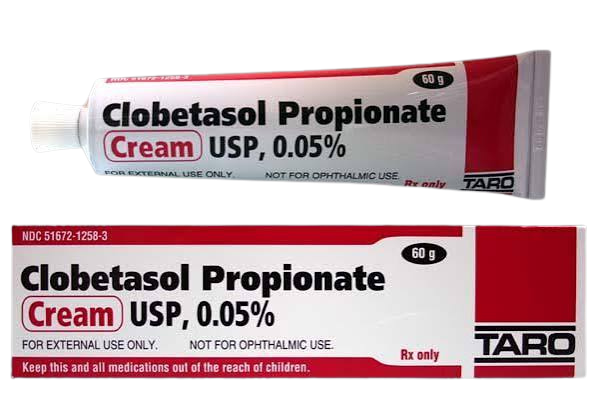
Clobetasol propionate 0.05% is Class I — the highest potency tier in the US topical steroid classification. It is not a default option for eczema, and most patients will never need it. It’s in the formulary because some presentations require it: severely thickened, lichenified patches on the trunk or extremities that have failed multiple mid-potency courses; eczema on the palms and soles where barrier dysfunction is extreme; or acute severe flares in adults where speed of clearance is the clinical priority.
The spray formulation has specific utility for eczema affecting the scalp and hair-bearing areas, where creams are difficult to apply and ointments aren’t practical. For refractory body or scalp involvement, clobetasol can achieve clearance within days that other agents cannot match in the same timeframe. Prescribing clobetasol is always accompanied by explicit instructions about duration and area limits.
Clobetasol propionate’s extreme potency comes from a combination of structural features: a fluorine atom at the 9-alpha position, a chlorine at the 21 position, and the propionate ester — all of which dramatically increase glucocorticoid-receptor affinity and skin penetration compared to lower-potency agents. Its receptor binding affinity is many times that of hydrocortisone.
Even a small amount, applied to a limited area, produces intense suppression of the inflammatory cascade: rapid, near-complete shutdown of NF-κB-driven cytokine production, pronounced vasoconstriction, and significant barrier-level anti-inflammatory activity. The spray delivers the molecule in a volatile carrier that evaporates quickly, allowing penetration without the occlusive effect of a cream or ointment — the reason it’s the preferred vehicle for hairy areas.
Clobetasol propionate has strong RCT evidence for both atopic dermatitis and psoriasis, including trials specifically examining short-course (2-week) use for severe flares. It consistently outperforms mid-potency agents on speed of clearance and complete-response rates for thick, established lesions. The FDA-approved labeling specifically includes atopic dermatitis.
The same evidence base clearly establishes the risk profile with extended use — which is why the 2-week maximum course limit is a regulatory and clinical consensus position, not an arbitrary caution.
Not for the face, neck, eyelids, groin, underarms, or any skin fold. At Class I potency, applying to thin skin can cause visible atrophy and telangiectasia within days. Not for children. Fern doesn’t prescribe clobetasol to patients under 18 — the HPA-axis suppression risk in pediatric patients on this potency class is not acceptable for routine eczema care.
Not for more than 2 consecutive weeks on any area, ever. The FDA label caps use at 2 weeks and 50 g per week for cream/ointment. Exceeding these limits significantly increases the risk of HPA-axis suppression — measurable cortisol suppression has been observed even at normal therapeutic doses over 2 weeks. Not for infected skin. The immunosuppressive effect at this level can let bacterial or viral infections spread quickly. If the flare hasn’t cleared in two weeks, that’s a signal for clinical escalation to systemic therapy or a biologic — not for extending the topical course.